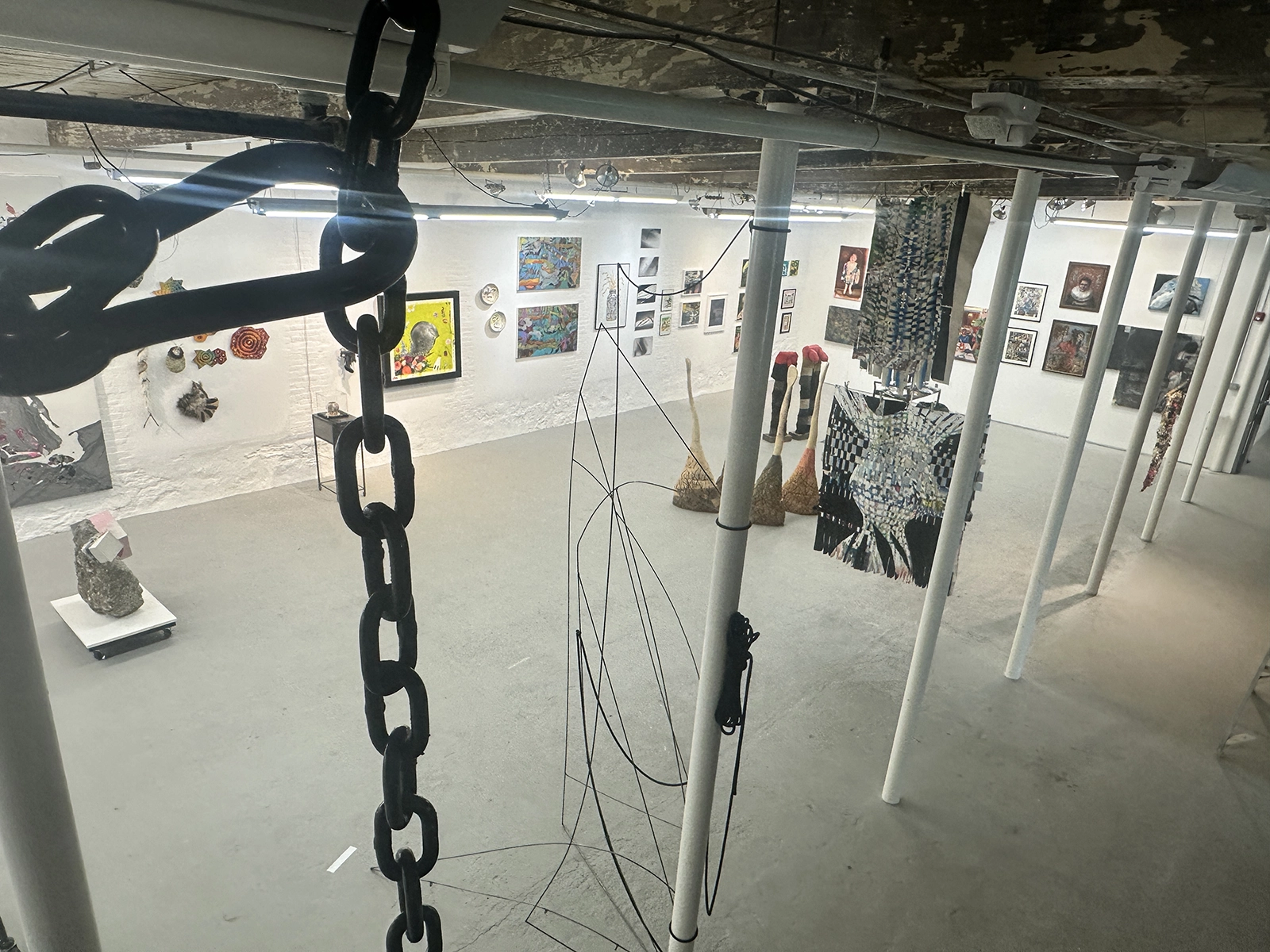

In the hushed, echoing expanse of a newly renovated gallery at 1 Canal Street, history and imagination entwine in rust, thread, and light. “Art Now in North Adams” isn’t just the name of the group show that opened Saturday night at Mixed Media Space—it’s a declaration, a grounding spell, and a reckoning. Featuring 46 artists, all with ties to this small post-industrial Berkshire city, the exhibition claims its place in the heart of a town that has, over the last few decades, made art and grit equally foundational.
Curated by Anna Salmeron and Sanja Stojakovic, the show marks the debut of this 2,000-square-foot gallery carved into a building that has lived many lives. If those walls could talk, they might whisper about silk, cotton, child labor, decay—and now, art. The new space, developed with Sanja Stojaković and her partner Ivan, is both a literal and metaphorical reclamation project, and this inaugural show is a fitting first breath.
Art Now in North Adams
Now through June 14, 2025
Gallery hours: Friday – Sunday, Noon to 5 p.m. or by appointment.
Groundart Studios, Mixed Media Space
1 Canal Street
North Adams, Mass.
Opening Reception: May 17, 6:00 – 8:00 p.m
The Curators: Mapping a Living Landscape
“There are hundreds of artists in this area,” Salmeron explained during a private press preview. “It was hard to narrow it down. But the criteria for this show narrowed it down by saying that people have to either live in North Adams or create art in North Adams… We could have easily had another 20 or 30 at the same level of production.”
Ivan explained the selection process even further. “And it was not about just, ‘oh, let’s just reach 46 artists in our town,’ he clarified. “It was finding whose practices are developed and dedicated, and then also finding various levels of artists because you have the level that’s beginner and you have somebody [like] Jarvis Rockwell who’s 93 and has a permanent show in Mass Moca as well as in the region. And then you have others in-between with similar directions. You know, they could be 30 or they could be 50 with maybe 20 years of experience, or maybe five years of experience. But the point is that they’re dedicated to their practice. They’re working now, and they’re acting now socially and as artists with a clear kind of body of work.”
Both Salmeron and the Stojakovics have deep connections to global art scenes—Ivan hails from Belgrade and has worked in Toronto and New York. Anna has long been embedded in the North Adams art world while nurturing far-reaching relationships. Together, they blend insider familiarity with outsider clarity, approaching curation as cartography: identifying where this moment in North Adams art history begins, and where it might lead.
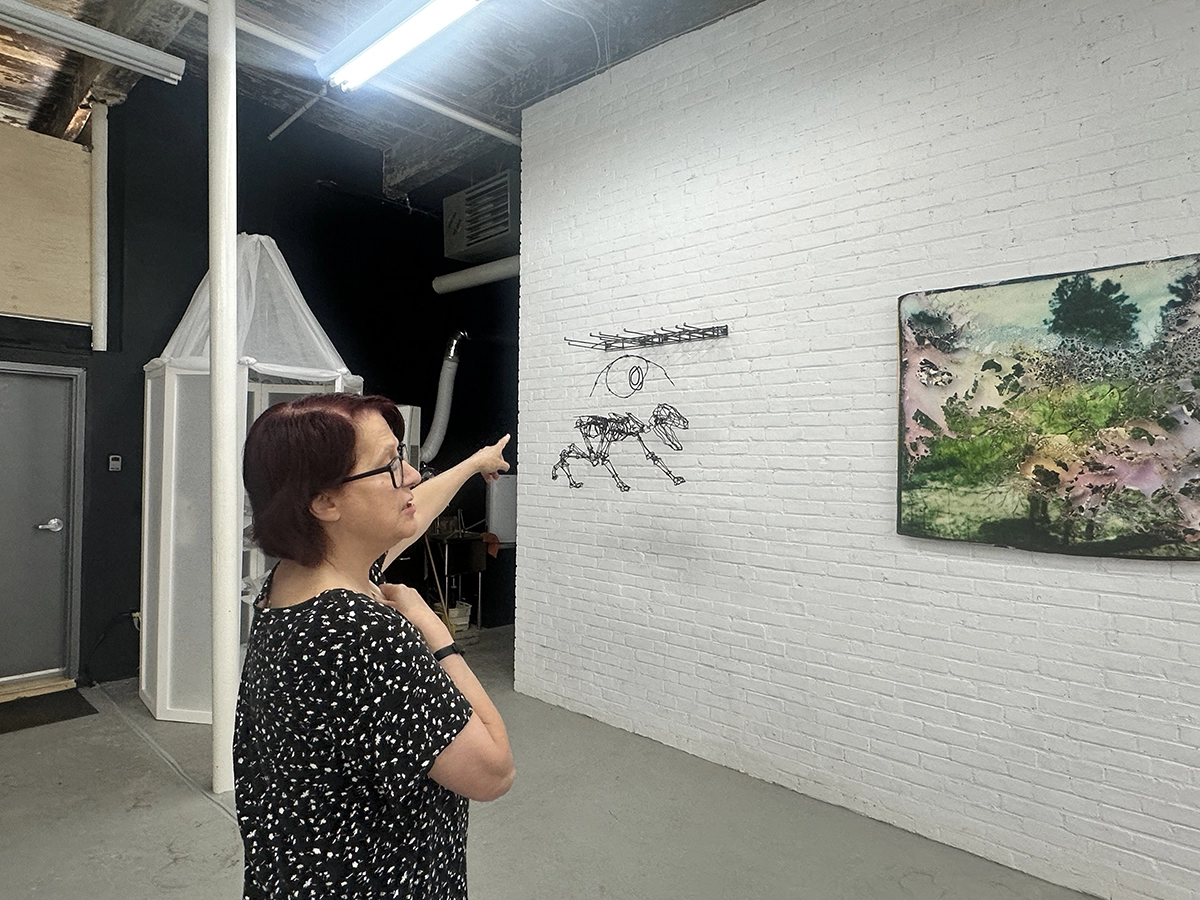
The resulting body of work pulses with variety: from printmaking and photography to sculpture, textile, installation, and painting. Some pieces are raw and weathered; others gleam with polish. Yet throughout the show, one theme surfaces again and again: reclamation. Reclamation of materials, certainly, but also of identity, of purpose, of place.
Anna Salmeron: A Protest in Pajamas
That theme finds playful and pointed form in Anna Salmeron’s own elevated installation, created with the Biennial Project. Draped in yellow—pillows, banners, blankets, and screen prints—the piece recreates a kind of activist slumber party, riffing on the group’s satirical campaign to be included in the Venice Biennale. Photos, editorial pillows, and video snippets fill the room, all vibrating with cheeky protest energy.
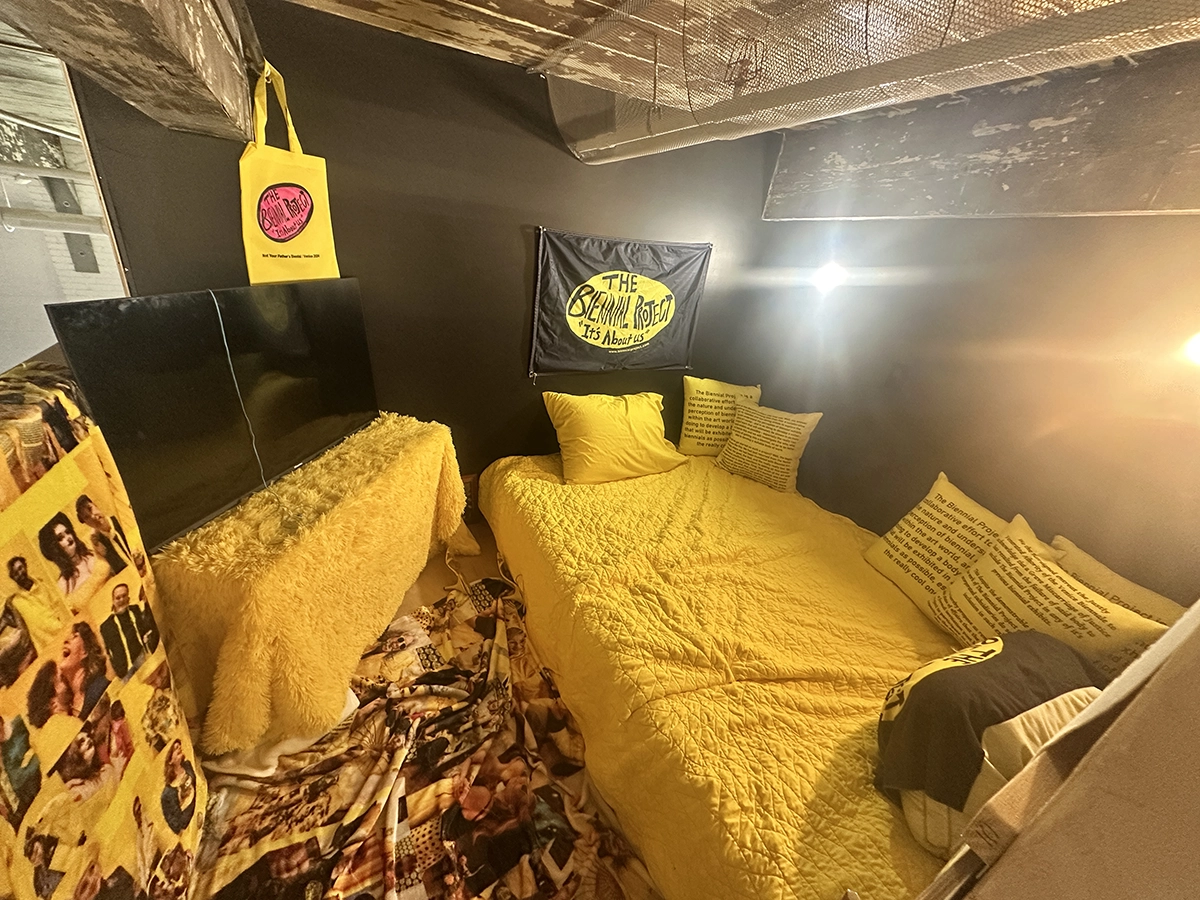
“We got about 50 people to go to the opening press week,” Salmeron recalled, “and we did a march through the streets, all dressed in yellow, to deliver hundreds of signed petitions demanding that they let us in the Venice Biennale. And all the happening black-clad people thought we were really weird. We’re not always.”
The installation is welcoming. It’s soft, silly, and defiantly unserious, yet it delivers a sharp critique of exclusionary art institutions. It also invites visitors to physically enter and linger, upending the stiff formality of many gallery experiences.
“So we’re very performative and very silly in a fun way,” she said. “Sometimes we think the art world takes itself a little too seriously.”
Sergio Demo: Resurrection Through Rust
Across the room, a large rusted mattress spring rises against a white wall like an old scar. Incorporated within the rectangle of coils are car parts and railroad ties that form the basis of the stubbornly defiant sculpture. This is one persona of the work of Sergio Demo, a former firefighter whose artistic practice often focuses on salvaging discarded materials and elevating them into quiet monuments.
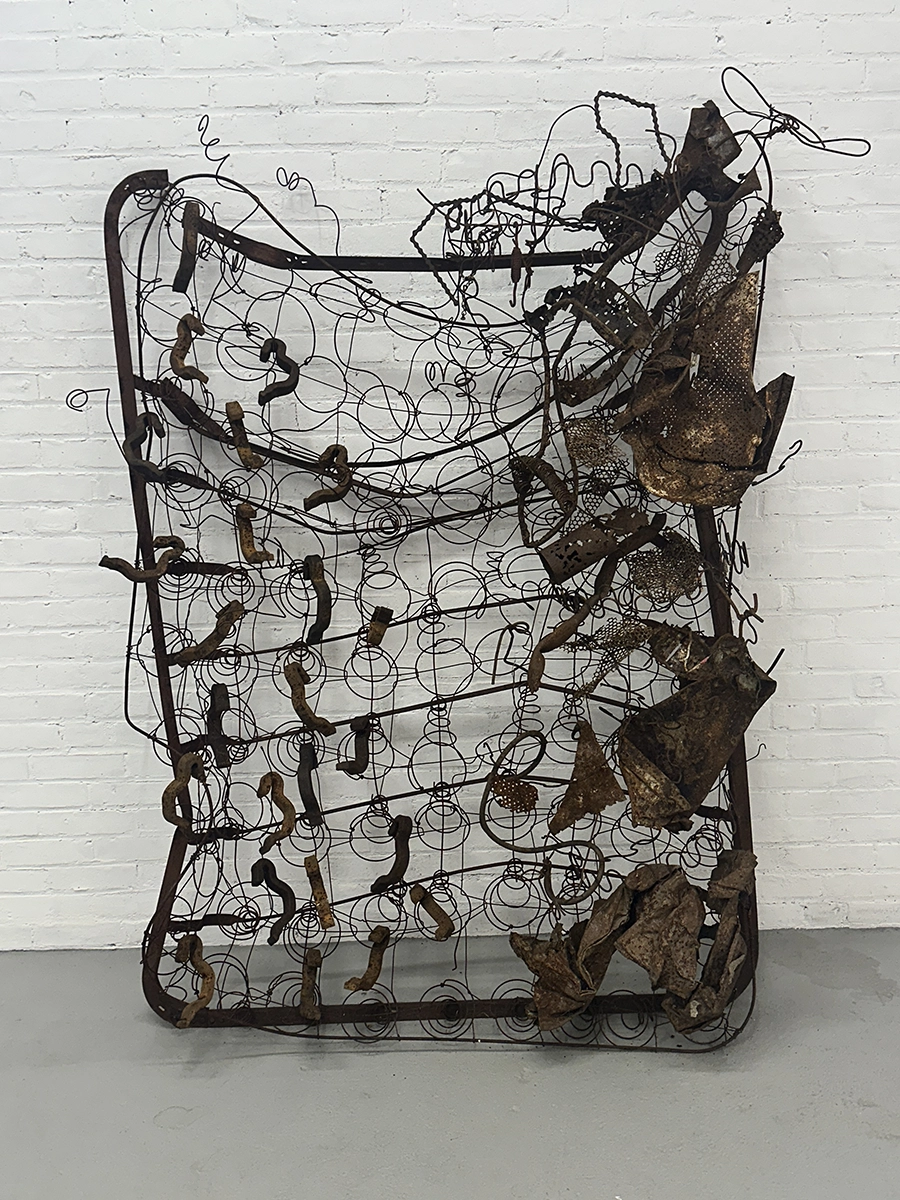
“Resurrection” is the word he uses to describe his approach—a spiritual act of giving new life to forgotten forms. His work, like his biography, is rooted in the trades and working-class reality of the town.
“He’s someone who respects the past and grew up in a different North Adams, but understands that although art doesn’t solve all problems, this town is in better shape than it would be without the artist,” Salmeron said.
Ivan agreed: “It’s extraordinarily beautiful. It’s very North Adams in a way, because there’s that rust.”
Demo is also a member of the Future Labs Gallery collective, which includes 20 artists working collaboratively on Eagle Street. His piece in this show stands as a love letter to the physical and emotional history of North Adams.
Rory Coyne: Queer Surrealism with Bite
If Sergio Denso reclaims rust, Rory Coyne reclaims imagery. His striking painting on display is a whirlwind of stylistic contradiction: a lush floral bouquet, a photorealistic medieval helmet, cartoon limbs, and a snarling pink sticker that reads, “Queer as in Fuck Off.”
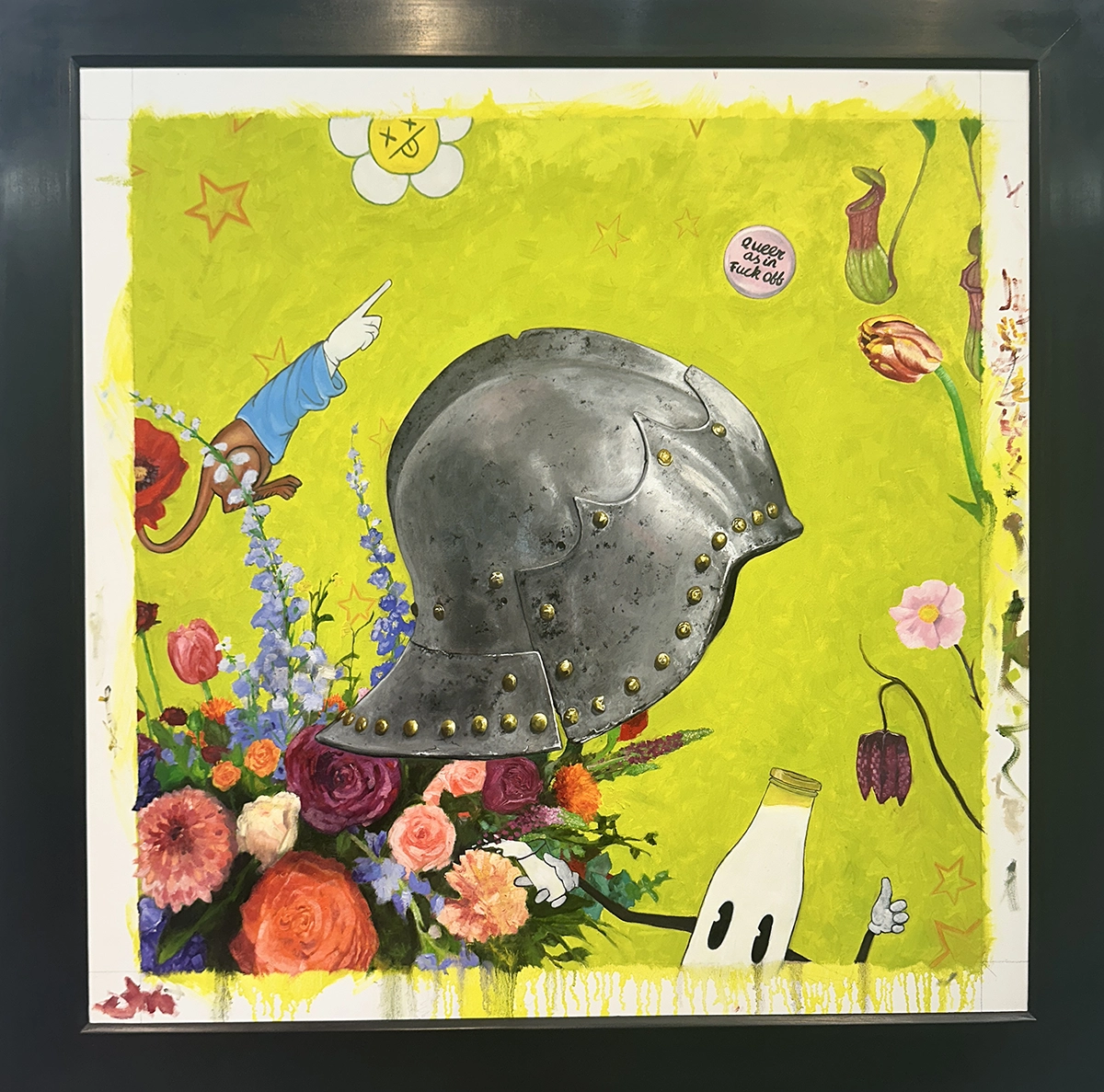
“It all shouldn’t work,” said Salmeron, pausing before the painting during the tour. “But it does.”
Coyne, who works as a fabricator at MASS MoCA, is a master technician with a trickster’s eye. His ability to merge 1930s cartoon aesthetics with high-gloss still life, surreal hybrid forms, and acidic commentary is dizzying. It’s sexy, strange, and packed with personality.
“He also does a lot of some explicitly erotic work. He submitted this for this show, but he has equally gorgeous, explicitly erotic work.”
It’s a strong example of the show’s willingness to hold multiple energies at once—tenderness and confrontation, humor and precision, identity and abstraction.
Dawn Nelson: A Diary of Distress
Artist Dawn Nelson fills an imposing section of the gallery wall with a grid of tear-off calendar pages, each day illustrated with a small hand-drawn image or phrase. Upon closer inspection, this is a visual diary kept every single day during the first Trump presidency.
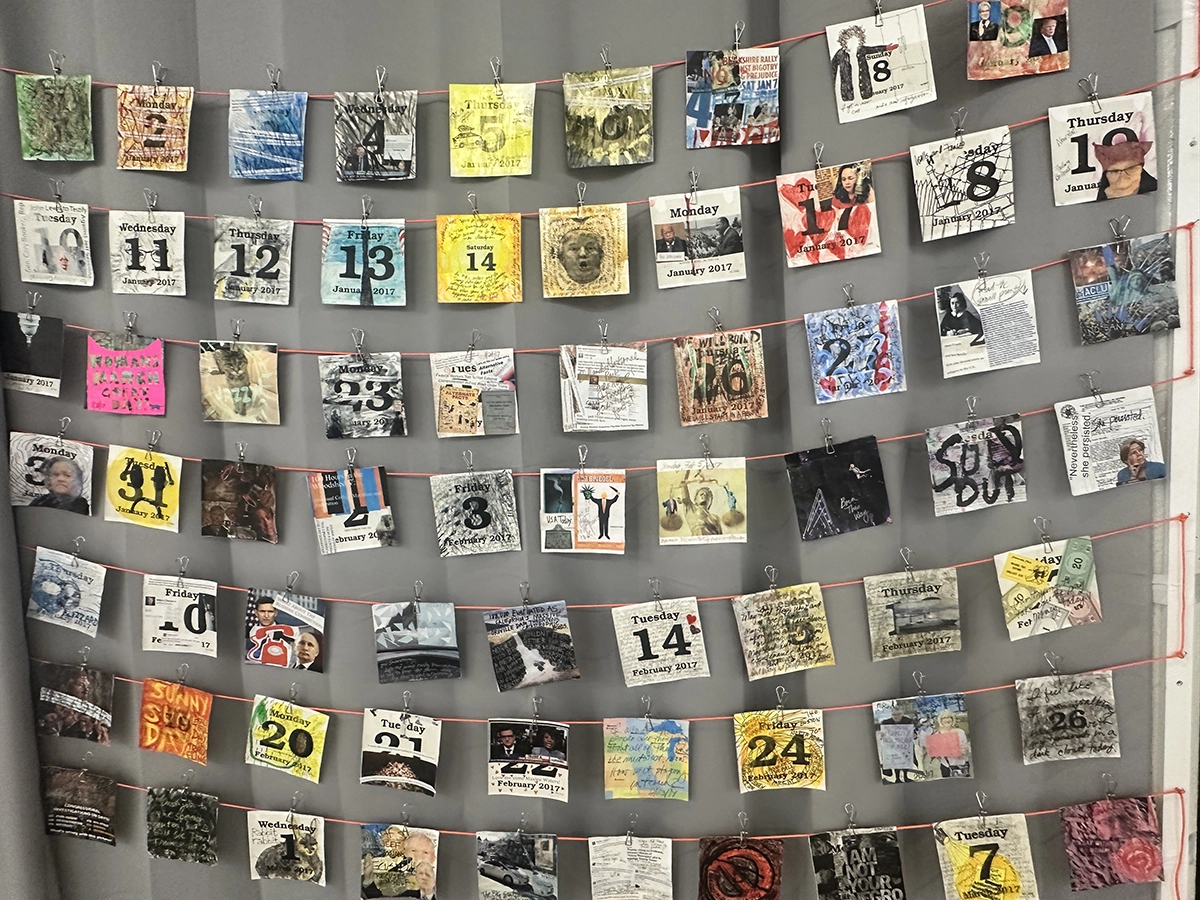
Some say “Evacuations in California: 188,000.” Another says, “Got cholesterol results.”
Salmeron described how the piece fit so well in the overall exhibition. “I like this because it does provoke thoughts and it’s visually compelling,” she said. “That was one of our unified criteria for the show, that there could be art that was conceptual and address issues of any kind. But that, number one, it had to be visually compelling without an artist’s statement.”
Ivan shared his thoughts on how art can convey ideas and emotions without necessarily trying to be overly persuasive. “Picasso showed us,” he said, “the deconstruction that the war does—the destruction, the collage reality of the war, the force of violence. But he’s not telling us what to think. I do not believe in art that’s telling us what to think. Even if it’s something I agree on, I think that’s propaganda.”
He continued, “This could have been propaganda, and we would still accept it as a part of the North Adams landscape of the artist that we are mapping. However, my own take on this piece, and the artist agreed, is that this is her personal diary. So this is her own processing of what it meant for her.”
You can express what you feel, “Ivan said. “You can be for or against. But the role of art…there’s more layers than that. It’s to create an experience in which you’re asking questions in a more profound way, like in [Picasso’s] Guernica. And I think she does it through a diary. So it’s way more compelling to say, okay, this is somebody, Wearing their heart on their sleeve. It’s very expressive, poetic, emotional. She’s emotionally processing. She’s showing us how it affected her. That’s one human that, to me, is way more compelling than if she came to me and said, ‘you know, whatever, fuck Trump.’ Because this is one human genuinely affected.
The Gallery: Raw Space, Real Intent
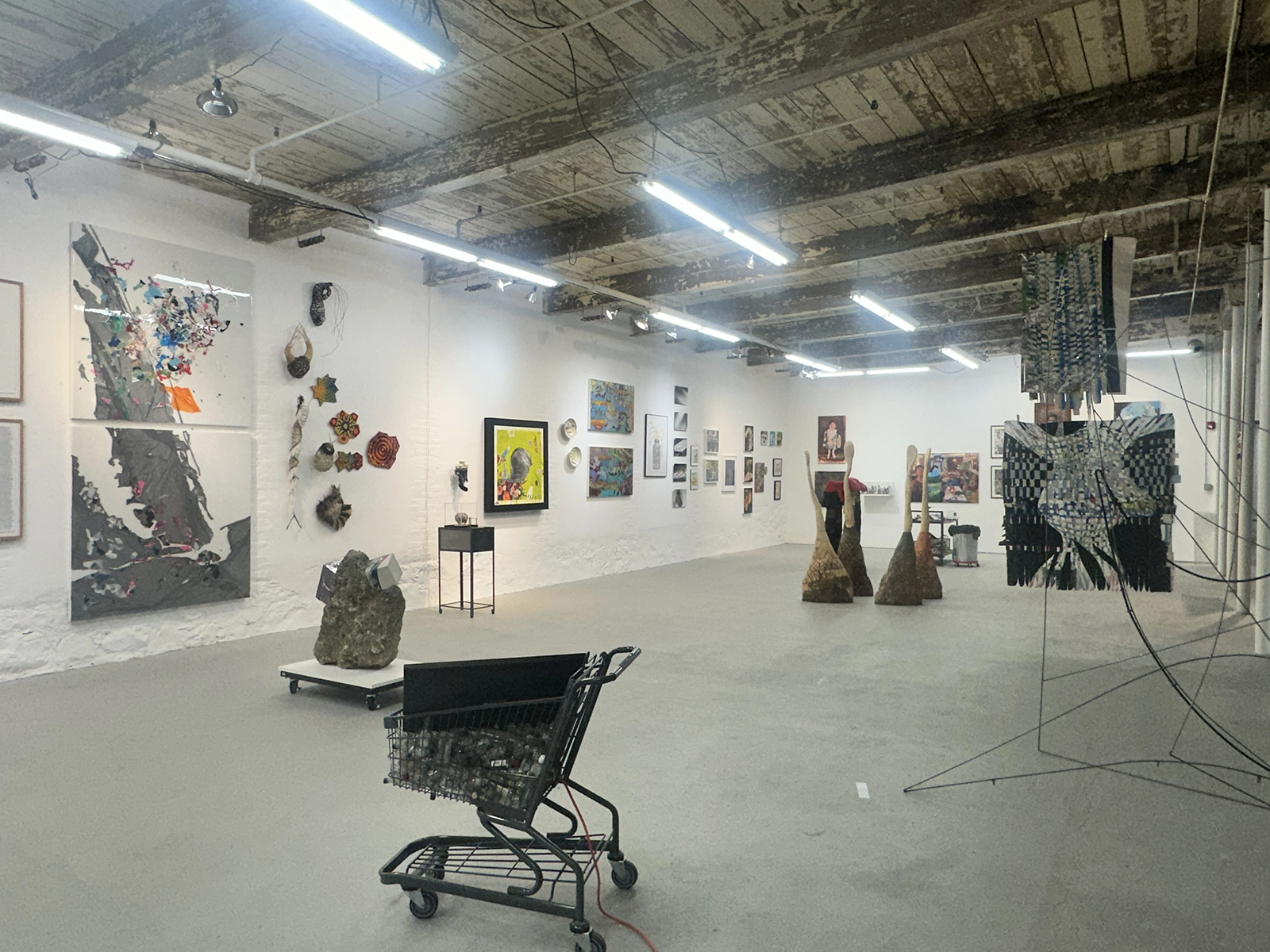
The space itself plays a critical role in the experience. Ivan and Sanja Stojaković renovated the building themselves, salvaging what they could and preserving its industrial character.
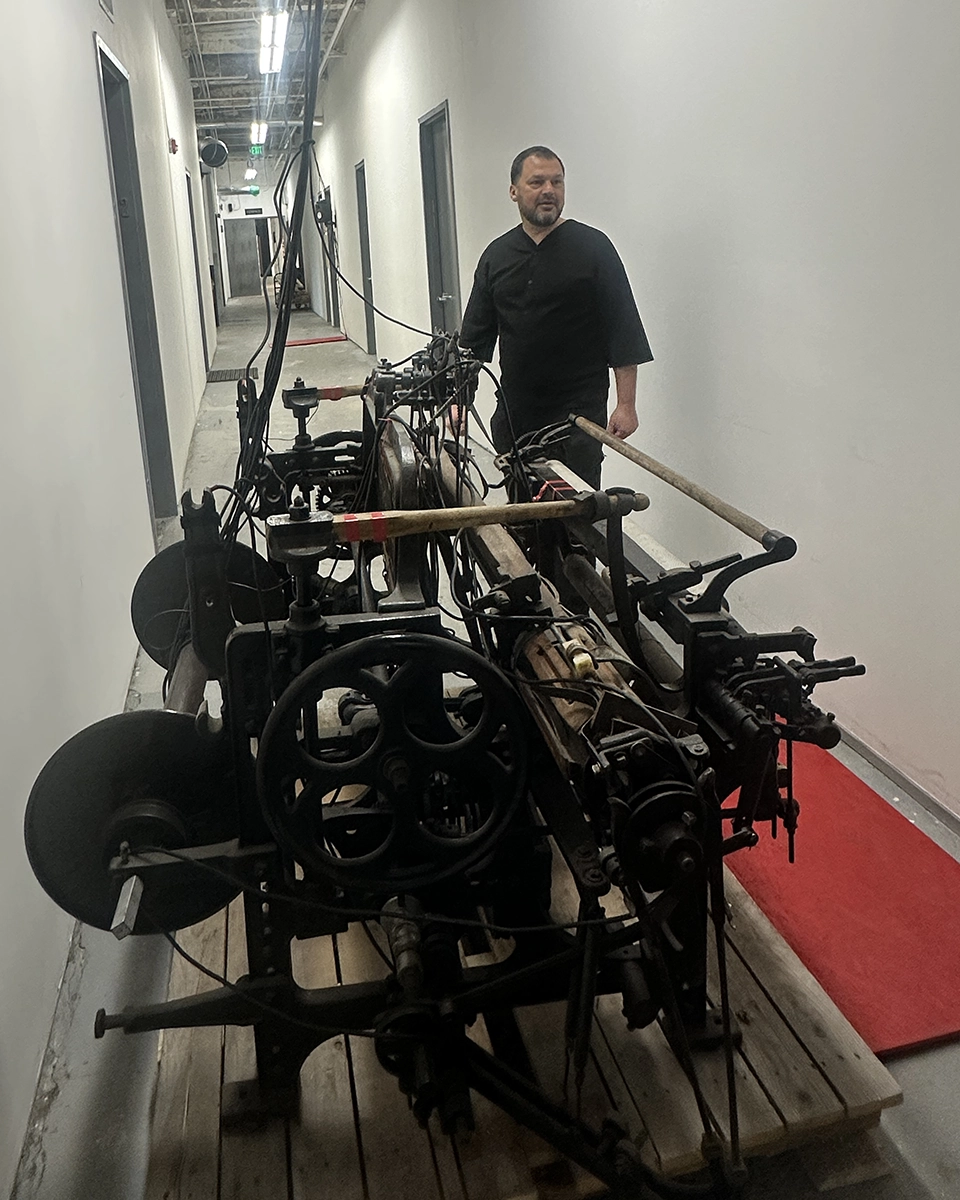
“That was one of the main attractions to come here, Ivan explained. It’s not just history as a story. It’s also that it’s alive. The remnants are still visible, and it hasn’t been converted to this kind of sterile new place. It actually has the patina, which is also the problem because there is blight. But at the same time, you literally get to see archeological sites. There’s decomposition behind this building. We dug out objects like toys from the 60s and 70s.”
Outside, the remnants of a mill town remain visible—brick stacks, broken windows, faded signs. Inside, art hangs where gears once spun. A vintage loom repurposed for a sound installation by Andy Lomax anchors one corridor, while other rooms bloom with fabric, found object, and photography.
One standout is Anna Farrington’s installation of a shopping cart filled with nip bottles, paired with a monitor displaying a photo of the cart in the alley where it was found. It’s a devastatingly quiet commentary on homelessness, addiction, and visibility.
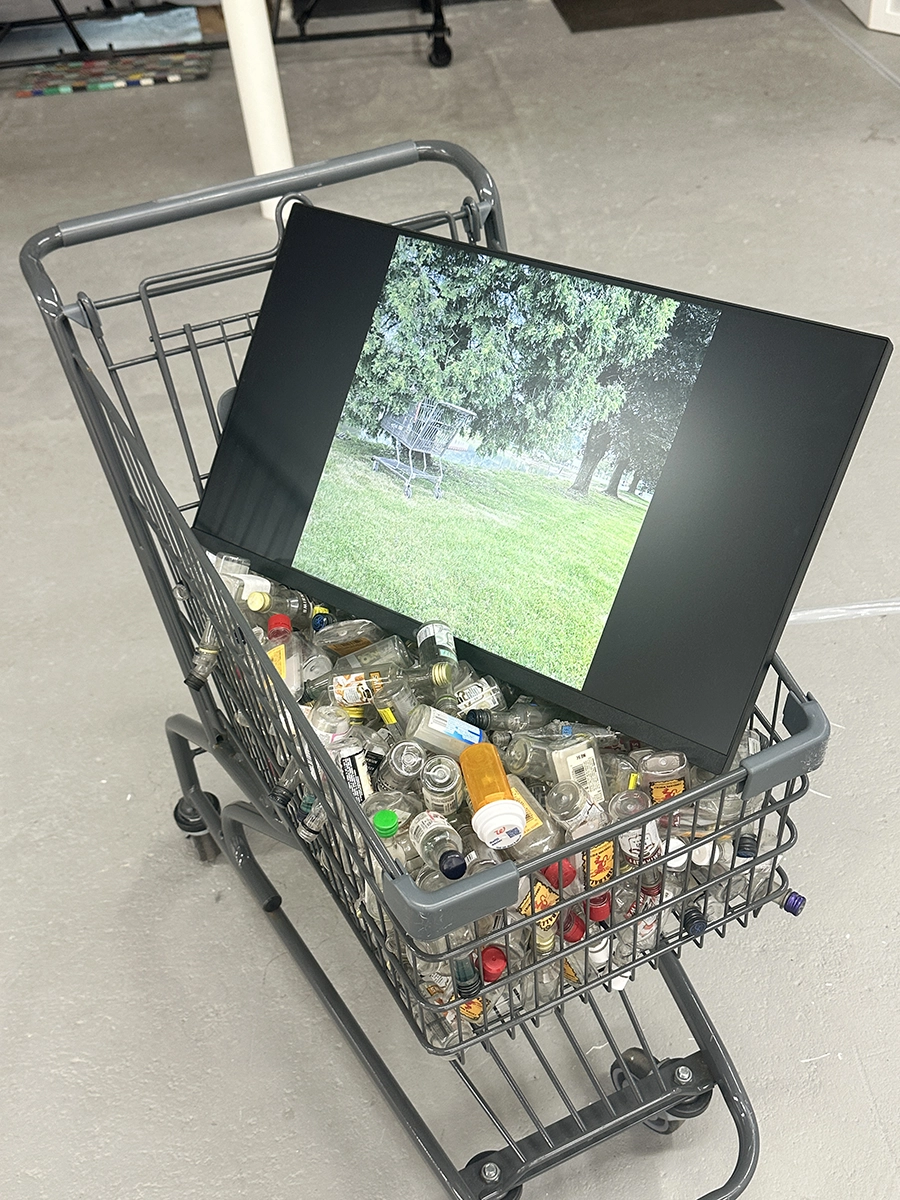
“There’s homelessness everywhere,” Anna said, “and there’s addiction everywhere. I would imagine most people leaving bottles on the street might have a bit of an issue with addiction, and probably not the resources to drink in their own homes. “
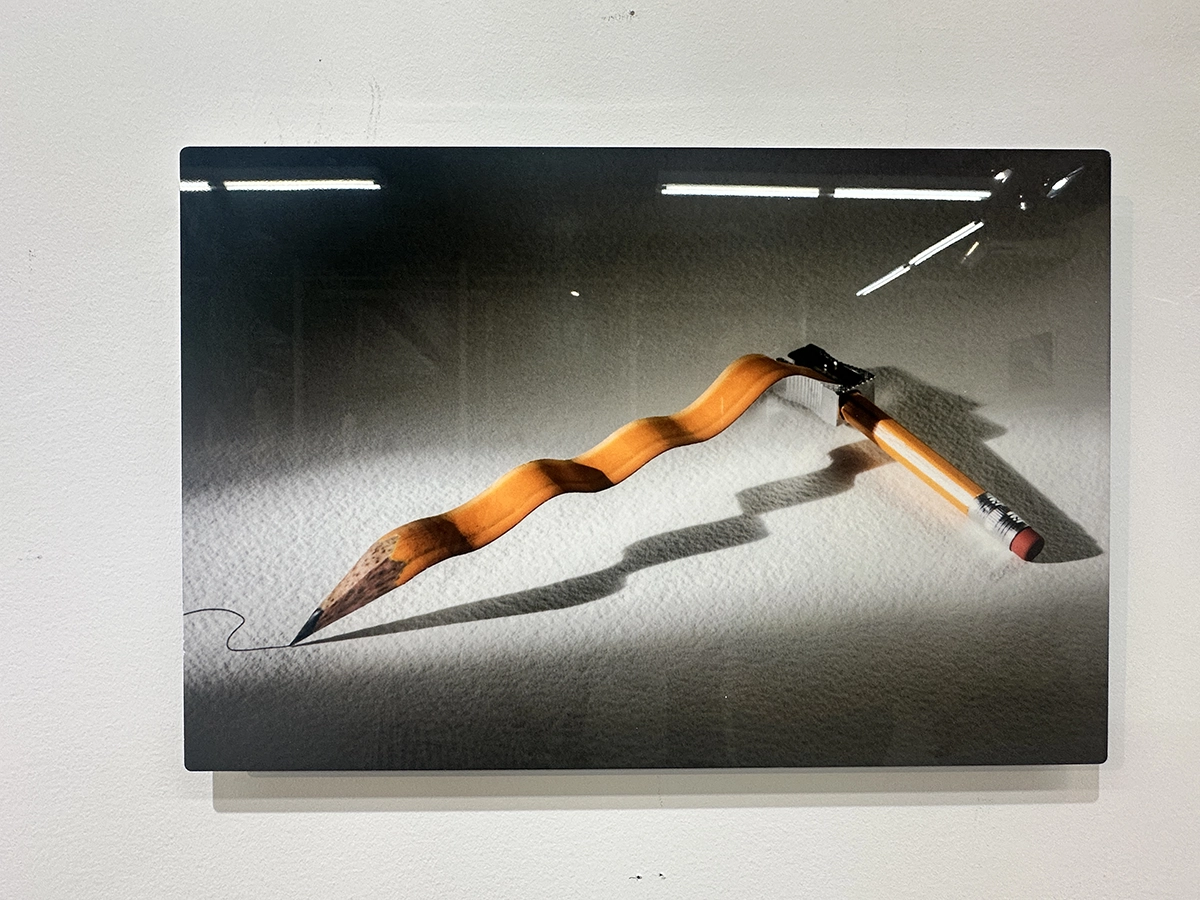
Another favorite: the manipulated photographs of Carlos Caicedo, joyful and surreal. “We could have picked 40,” Salmeron said. “He lives in the Eclipse Mill and his work just radiates happiness.”
Art, Labor, and Living Dualities
Several of the artists in the show work at MASS MoCA as fabricators, constructing other artists’ large-scale visions. Here, they present their own work.
“These conversations are also very interesting today, because the contemporary art world has become way less about the hands on making,” Ivan noted. “It has become this kind of delegated work that’s directed by the artist and executed by fabricators. And there are questions of value and what we value. Is this what we value or do we value that the artist actually is hands-on involved and controls the making process? And that’s considered old school because it used to be that the-artist-makes. And now we’re moving more and more towards the-artist-directs and other people make. But that also becomes this kind of corporate art.”
Looking Ahead
“Art Now in North Adams” is just the beginning. The Stojakovićs plan to host two curated shows each year, allowing time for depth, community engagement, and possibly international collaborations in the future.
Salmeron seems pretty sure mounting another such grand exhibition shouldn’t be too difficult, at least as far as contributors go.”
“This is a very fertile town,” she said, “and it attracts a lot of artists and nurtures a lot of artists.”
The show runs through June 14, with a closing reception planned that promises to be as full of conversation and curiosity as the opening. Until then, the works will hang there, waiting for visitors to wander in off the street and find something unexpected—a laugh, a question, a memory, a moment of recognition.
Reclamation is rarely tidy. It’s messy and tender and loud and sometimes funny. In this show, it’s also beautiful.
“Art Now in North Adams” runs through June 14, 2025, at Mixed Media Space, 1 Canal Street, North Adams, MA. Gallery hours are 11 a.m. to 5 p.m. daily.


Thanks Brother